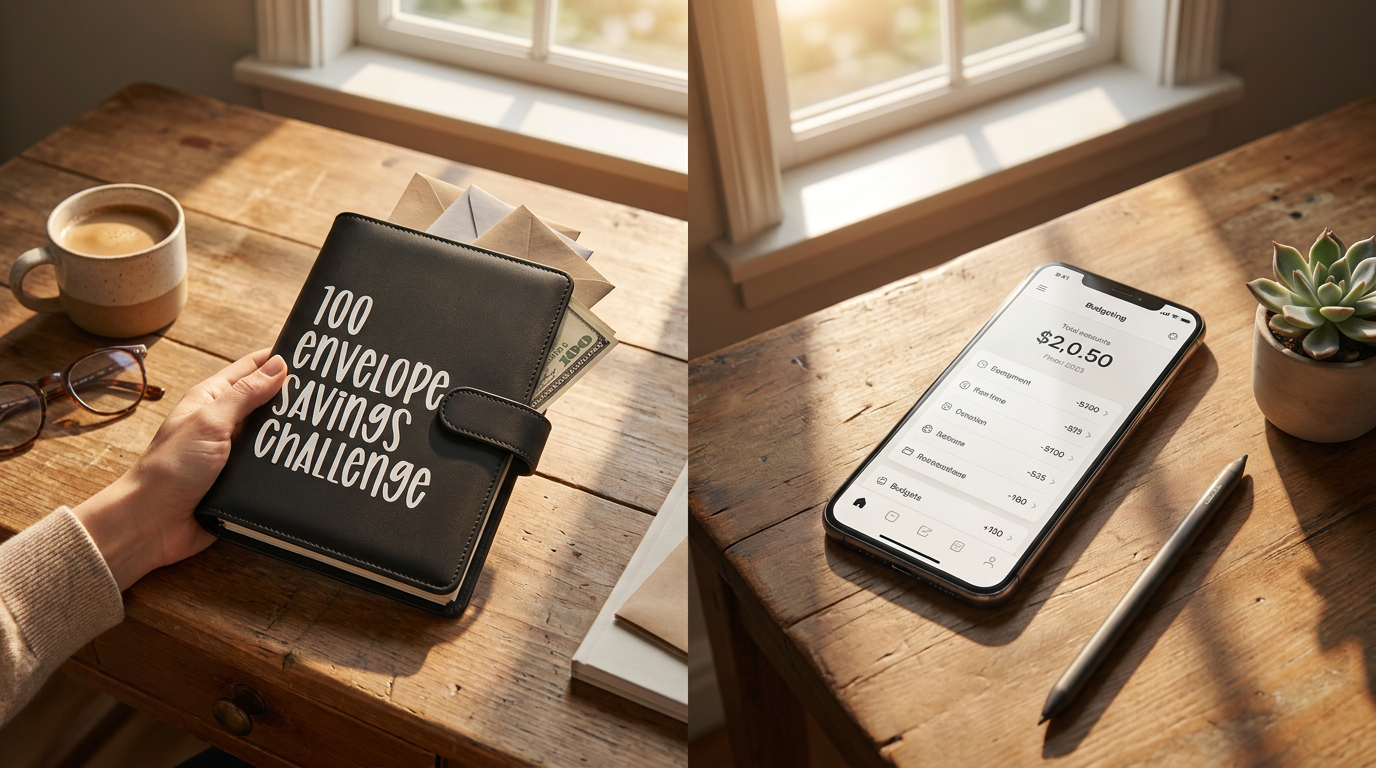
Binder vs. App: The Wrong Debate for the 100 Envelope Challenge
The debate over using a 100 envelope challenge binder versus a savings app typically centers on the psychological benefit of physical cash versus digital convenience. This comparison misses the most critical factor for savers: the financial drag created by holding physical currency. While gamified apps and tactile binders both aim to help you save $5,050, only one of these methods actively costs you money in the process.
The conventional wisdom says the binder's strength is its tangibility. Physically stuffing an envelope creates a powerful feedback loop that digital interfaces struggle to replicate. Here's the part nobody talks about: every dollar sitting in a binder sleeve is a non-performing asset. It earns no interest and loses purchasing power to inflation daily.
Run the math: If you complete the challenge over 100 weeks, your average balance held in cash is over $2,500. With high-yield savings accounts offering APYs of 4.25% or more, as reported by outlets like Bankrate, you could be forfeiting over $100 in interest. While the amount is smaller over a 100-day timeline, the principle remains. Cash is a depreciating asset, and a savings strategy should not ignore this fact.
This doesn't render the binder obsolete. It simply reframes its purpose. The binder is not a vault; it is a commitment ledger. Its primary function is to provide a visual and tactile system for tracking progress, which is a proven method for habit formation. The key is to learn how to organize a 100 envelope challenge binder as a dashboard, not a bank. You mark off the envelopes as you transfer the corresponding funds into an interest-bearing account.
Savings apps, while financially efficient, often fail on the commitment front. A push notification is easily dismissed, and a digital progress bar lacks the physical presence of a binder on a desk. The viral success of the TikTok 100 Envelope Challenge Binder is evidence of the power of a physical artifact in maintaining motivation. It creates a form of social and personal accountability that a line of code cannot.
The optimal approach is a hybrid model. Use the binder as the physical interface for the challenge—the tool you interact with daily or weekly. Then, transfer the actual funds to a separate high-yield account to put your money to work. This allows you to see your 100 envelope challenge binder results in a tangible way while maximizing your financial outcome. I'll change my mind when a savings app can create a physical, non-dismissible token of commitment that lives in the user's environment.
Is a 100 envelope binder better than a savings app?
A binder is a superior behavioral tool for building commitment, while a high-yield savings account is a superior financial tool for growing wealth. An app alone lacks the physical reinforcement many users need. The most effective strategy combines the binder for tracking and motivation with a separate, interest-bearing account for holding the actual funds.Does the 100 envelope challenge actually work?
Photo by Monstera Production on Pexels
The challenge works as a behavioral framework for building a consistent savings habit. Its success depends entirely on user consistency, and a physical binder is a powerful tool designed to reinforce that commitment. By providing a clear, gamified structure, it makes the abstract goal of saving money concrete and achievable.