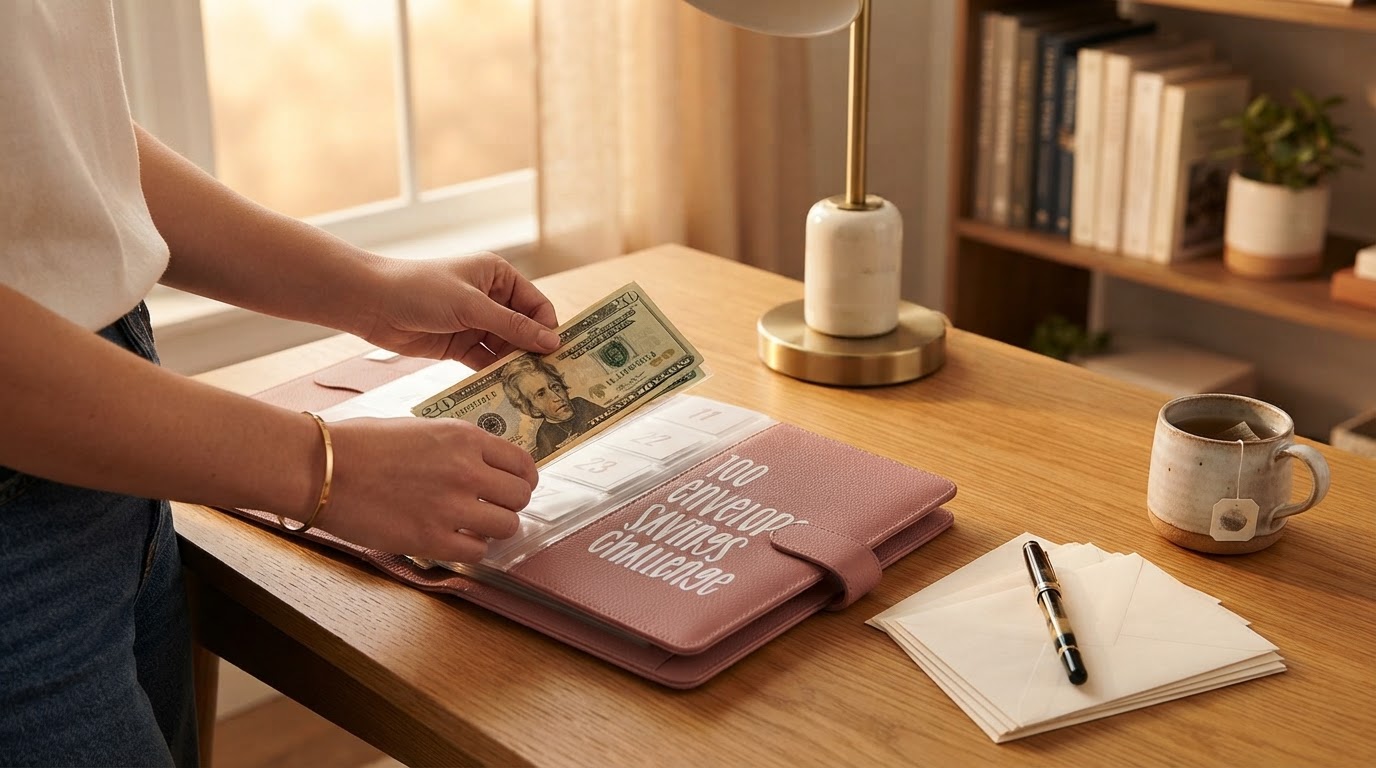
How does the money saving binder 100 day challenge work?
September 4, 2026 — The money saving binder 100 day challenge is a gamified financial strategy where a participant populates a 100-slot binder with daily cash increments to reach a specific savings target, most commonly $5,050.
The conventional wisdom says that physical cash stuffing is an obsolete relic in a digital economy, yet search volume for "savings challenge binder" continues to grow, particularly among consumers seeking a tactile barrier to impulsive spending. By removing money from a liquid bank account and placing it into a physical 100 Envelope Challenge Binder, users create a psychological friction that digital transfers often fail to replicate.
How much money do you save with a 100 day binder?
You save exactly $5,050 if you follow the standard sequential numbering from 1 to 100, though the daily contribution volatility is the part nobody talks about. While the average daily deposit is a manageable $50.50, the reality is that the final ten days of the challenge require a total outlay of $955, which can destabilize a standard monthly budget if not planned for in advance. Thrivent notes that the 100 envelope challenge is specifically designed to help set aside $5,050 in 100 days using these small, incremental contributions. However, for those using a 100 Envelope Challenge Kit, the mathematical outcome is fixed regardless of the order in which the envelopes are filled. If a user fills the envelopes out of order to manage cash flow, the total remains the same, but the psychological "win" of completing a daily task is preserved without the end-of-challenge financial strain.
What are the physical requirements for a 100 day challenge?

Photo by Monstera Production on Pexels
A functional challenge requires a sturdy 6-ring binder, typically A5 size, equipped with 25 four-pocket pages to accommodate 100 individual slots. Run the math: a standard binder must be durable enough to hold 100 separate bills or stacks of bills, which adds significant bulk and puts stress on magnetic closures. Peter Pauper Press produces a version that includes 100 pre-numbered envelopes and a magnetic closure flap to address this specific physical expansion. Beyond the binder itself, success depends on a reusable tracker to prevent double-counting. I'll change my mind about the necessity of these specialized binders when digital banking apps can replicate the dopamine hit of physically crossing off a number on a success with a 100 envelope challenge binder tracker. Without the physical constraints of the binder, the challenge often dissolves into a disorganized pile of cash that is too easily raided for daily expenses.
Quick answers
Q: Can you do the 100 day challenge with less than $5,050? A: Yes, by using a save 5050 in 100 days binder but labeling envelopes with smaller increments, such as $1 to $50 twice, you can target a $2,550 goal instead. Some users even utilize $0.50 increments to reach a $2,525 total.
Q: What is the best way to organize the binder to ensure success? A: According to instructions on how to use 100 envelope challenge binder, users should start with the highest-numbered envelopes on days when they receive a paycheck to reduce the burden of the $90-$100 envelopes later in the month.
Q: Are there DIY alternatives to buying a pre-made binder? A: Pinterest data shows that at least 76 people have recently searched for DIY 100 envelope challenge binder ideas, which typically involve using a standard photo album or a customized 6-ring binder with hand-labeled plastic sleeves.
Learn more about 100 Envelope Challenge Binder at https://envelopeschallenge.com.
Sources

Photo by Dany Kurniawan on Pexels
- My 100 Envelope Savings Challenge Binder - Peter Pauper Press
- Black 100 Envelope Saving Challenge Binder With ... - YouTube
- 100 Envelope Challenge: Pros, Cons & Other Budgeting Tips | Thrivent