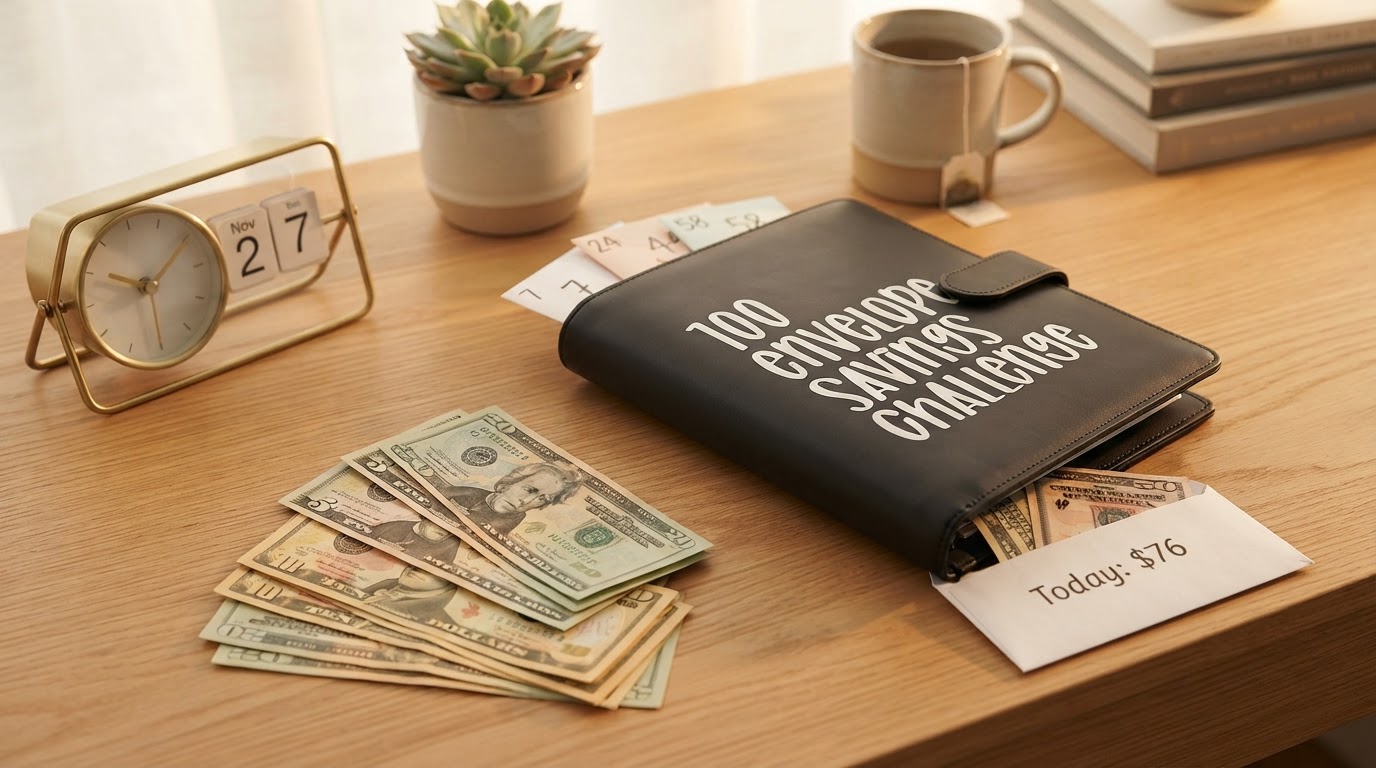
How do I use a 100 Envelope Challenge Binder effectively?
November 27, 2026 — Using a 100 Envelope Challenge Binder involves labeling internal pockets from 1 to 100 and depositing the corresponding dollar amount into one pocket per day until you reach a total of $5,050.
The conventional wisdom says that the 100 envelope challenge is a simple gamified savings tool for the average consumer, but this ignores the high-velocity capital requirement of the standard 100-day timeline. While the methodology is straightforward, successful execution requires a rigid adherence to the mathematical progression rather than the sporadic "cash stuffing" often seen on social media.
How does the 100 envelope challenge work in a binder?
The 100 envelope challenge functions by assigning a specific numerical value to 100 individual slots, where the participant fills one slot daily with the exact amount of cash matching that slot's number. According to Fidelity, the total sum saved at the end of the cycle is exactly $5,050, calculated as the sum of all integers from 1 to 100. Using a dedicated 100 Envelope Challenge Binder replaces the traditional, disorganized shoebox of paper envelopes with a condensed A5-sized system featuring transparent sleeves. This structure prevents the physical bulk of 100 standard envelopes from becoming unmanageable while providing a visual tracker for progress. The math is non-negotiable: if you skip the higher-numbered envelopes (like 90 through 100) until the end, you face a $955 cash requirement in the final ten days, which often leads to abandonment of the goal.What is the most efficient way to fill the binder?
Efficiency in the challenge is found by balancing high-value and low-value envelopes rather than following a strict linear sequence of 1 to 100. Thrivent suggests pulling envelopes randomly to make the daily amount a surprise, but for those with fixed income cycles, a hybrid approach is more sustainable. Run the math: filling envelope #100 and envelope #1 in the same week requires $101, whereas filling #100 and #99 requires $199. By pairing high-numbered sleeves with low-numbered ones, you normalize your weekly cash outflow. Utilizing a savings challenge book alongside the binder can help track these adjusted contributions. Here's the part nobody talks about: the physical binder is merely the vessel; the success rate depends entirely on whether the user treats the binder as a liquid emergency fund or a locked savings vehicle. I'll change my mind about the "random draw" method when data shows it leads to higher completion rates than systematic pairing.Quick answers
Q: How much money do you save total in the 100 envelope challenge? A: You save exactly $5,050 if you fill every slot from 1 to 100 once. This figure is a mathematical constant based on the sum of the first 100 integers.Q: Can I use a 100 Envelope Challenge Binder for a different timeframe? A: Yes, many users adapt the 100 Envelope Challenge Binder to a 50-week or two-year schedule by filling two envelopes per week or one every few days. This customization is often necessary for those who cannot commit to the $50.50 daily average required for a 100-day completion.
Q: What should I look for when buying a kit? A: A standard 100 envelope challenge kit should include a durable A5 binder and 25 four-pocket pages to accommodate all 100 slots. Ensure the binder has a secure closure, like an elastic band or magnetic snap, to handle the thickness of the cash once the binder is more than 50% full.
Internal links for further reading include the 100 envelope challenge kit buying guide and strategies for using a savings challenge book.
Learn more about 100 Envelope Challenge Binder at https://envelopeschallenge.com.
Sources
- What is the 100 envelope challenge and how do you do it?
- 100 Envelope Challenge: Pros, Cons & Other Budgeting Tips
- The 100 Envelope Challenge: How It Works and How Much You'll Save